You usually do not need more content ideas. You need fewer decisions between idea and publish. That is the real issue behind inconsistency, and it is why learning how to plan content consistently matters more than chasing motivation.
For creators, freelancers, and small business owners, content often gets pushed behind client work, admin tasks, and last-minute requests. The result is familiar: a burst of posts, a gap of silence, then the feeling that the whole system needs to be rebuilt. In most cases, it does not. What you need is a planning process simple enough to repeat even during busy weeks.
Why consistency breaks down
Most content plans fail because they ask for too much precision too early. You open a blank calendar and try to decide every topic, every platform, and every publish date for the next month. It feels organized for a moment, then real work happens and the plan starts slipping.
There is also a second problem: too many businesses treat content as a creative task only. In practice, consistent content is an operations task. Ideas matter, but structure matters more. If your planning system depends on having extra time, high energy, or a sudden wave of inspiration, it is not really a system.
A consistent process should reduce decisions, show priorities clearly, and make the next step obvious. If it takes too long to maintain, you will stop using it.
How to plan content consistently with less friction
The easiest way to stay consistent is to separate content planning into smaller layers. Instead of planning everything at once, decide your direction first, then your topics, then your production schedule. This keeps the work clean and manageable.
Start with a content rhythm you can actually sustain. Weekly content is better than an ambitious daily plan that collapses after ten days. The goal is not maximum output. The goal is repeatable output.
A simple planning structure often works best when it includes four parts: content pillars, a realistic publishing cadence, a place to store ideas, and a short production workflow. That is enough for most solo businesses and lean teams.
Choose 3 to 5 clear content pillars
Content pillars give your planning boundaries. They answer a basic question: what should this business talk about regularly?
For a freelance designer, that might be client education, process tips, brand strategy, and case-study style insights. For a service business, it might be common client questions, behind-the-scenes workflow, expertise, and proof of results. The exact categories depend on the business, but they should be stable enough to guide decisions for months, not days.
This is where many people overcomplicate things. You do not need ten categories. You need a small set that reflects what you sell, what your audience needs, and what you can talk about with confidence.
When your pillars are clear, content planning gets faster. You are no longer asking, “What should I post?” You are asking, “Which pillar needs attention this week?” That is a much easier decision.
Set a publishing cadence based on capacity
The fastest way to break consistency is to build a plan around your best week instead of your average one.
Look at your actual schedule. If you manage client work, sales, admin, and delivery on your own, publishing three strong pieces a week may not be realistic. One article, two short-form posts, or one email plus a few social posts may be a better fit. A smaller cadence you can maintain builds more momentum than a larger one you keep resetting.
It also helps to define what “published” means for your business. For some brands, that means a blog post every week. For others, it means consistent short-form content and one deeper piece each month. It depends on your business model, audience behavior, and available time.
The key is to choose a rhythm that survives busy periods. If your plan only works when nothing unexpected happens, it is too fragile.
Build a lightweight planning system
If you want to know how to plan content consistently over the long term, the answer is rarely a bigger tool. It is a cleaner workflow.
Your system does not need to be complex. It needs to answer four questions quickly: what are we publishing, why does it matter, when is it due, and what is the next step?
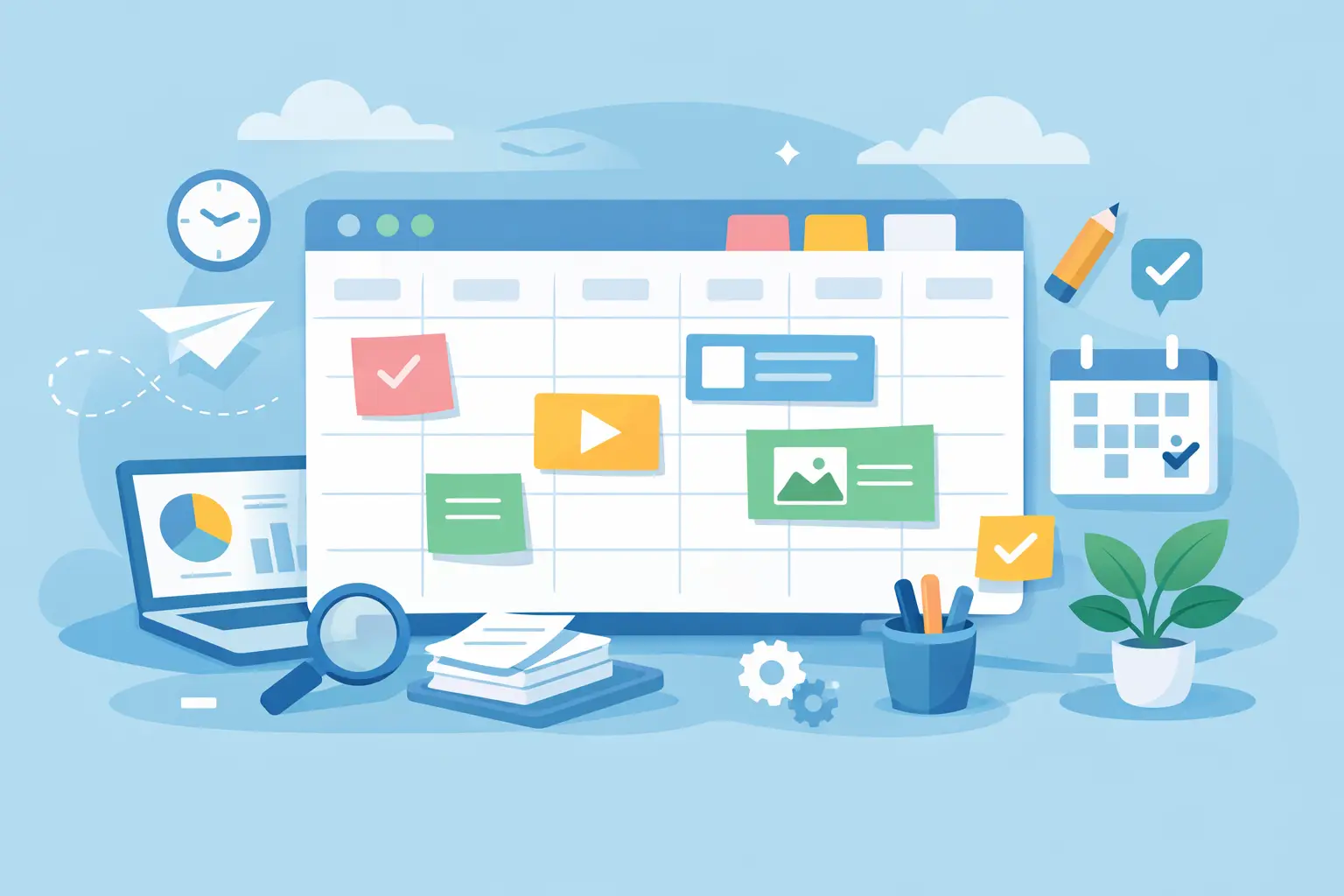
A practical setup can be very simple. Keep one place for raw ideas, one place for your active content calendar, and one place for production status. That might be a spreadsheet, a template, a project board, or a structured document. The format matters less than the clarity.
What usually causes friction is scattered planning. Ideas live in notes, drafts live in another app, deadlines sit on a calendar, and nothing connects. Every time you return to content, you have to rebuild the context. Clean systems remove that restart cost.
Create a repeatable weekly planning block
Consistency improves when planning becomes a routine instead of a rescue task.
Set one short block each week to review upcoming content. During that session, choose topics, assign dates, and confirm what needs to be drafted or scheduled next. This does not need to take hours. In many cases, 30 to 45 minutes is enough if your content pillars and workflow are already defined.
Use that time to make practical decisions, not perfect ones. Pick the next topics. Match them to business priorities. Move unfinished ideas forward or cut them. A planning session should create momentum, not become another form of procrastination.
Weekly planning also keeps your calendar responsive. If client demand shifts, if a launch moves, or if a topic no longer feels timely, you can adjust without rebuilding your entire month.
Work from themes, not random ideas
Random ideas create random output. Themes create coherence.
Instead of filling your calendar one isolated post at a time, assign a focus to each week or month. That focus could align with a service offer, a common customer problem, a seasonal demand pattern, or a recurring business priority. Then build several content pieces around that theme.
This approach makes content creation easier because each piece supports the next. One blog post can become short-form posts, email points, and follow-up ideas. You spend less time starting from zero.
It also improves the audience experience. Your content feels more deliberate when multiple pieces reinforce the same message from different angles.
Make production easier than planning
A good content plan still fails if production is too heavy.
This is where templates help. When your content outline, caption format, review process, or publishing checklist already exists, each piece takes less setup time. You save energy for the actual message instead of repeatedly deciding how to structure it.
There is a trade-off here. Too much structure can make content feel flat. Too little structure creates inconsistency and delay. The best middle ground is a flexible framework: enough standardization to move quickly, enough room to adapt the message.
For example, your workflow might always follow the same sequence – idea, angle, draft, edit, schedule – while the content itself changes by platform or campaign. That gives you consistency in process without forcing sameness in tone.
Plan one step ahead, not ten
Many business owners abandon content systems because they try to engineer the entire quarter before writing the next post.
A better approach is to stay one clear step ahead. Keep a broader monthly view, but focus operationally on the next one to two weeks. That gives you enough visibility to stay organized without turning planning into a large maintenance project.
This matters especially for small teams and solo operators. Your schedule changes quickly. Client work can expand. New opportunities appear. A lighter planning horizon is often more durable than a rigid long-range calendar.
What to do when consistency slips
It will slip sometimes. That does not mean the system failed.
When content slows down, do not start by redesigning everything. First, look for the actual bottleneck. Are you choosing too many topics? Is the cadence too aggressive? Are drafts getting stuck in review? Is your system spread across too many tools?
Most consistency problems come from one of three issues: too much volume, unclear workflow, or no dedicated planning time. Fix the pressure point before changing the whole process.
It also helps to keep a short list of low-effort content formats for busy weeks. These can fill gaps without lowering quality. The point is not to publish for the sake of it. The point is to maintain your rhythm when capacity dips.
Clean planning is not about perfection. It is about making content easier to continue.
A consistent content system should feel calm. It should help you see what is next, keep your message organized, and reduce the amount of time spent starting over. If your current process feels heavier than the content itself, simplify it until it becomes usable. That is usually where consistency starts.